If you like Webflow for design but want more control over where a site lives, exporting to static HTML is the practical path. It lets you keep the visual build experience while moving delivery to your own hosting, Git workflow, S3 bucket, or FTP server.
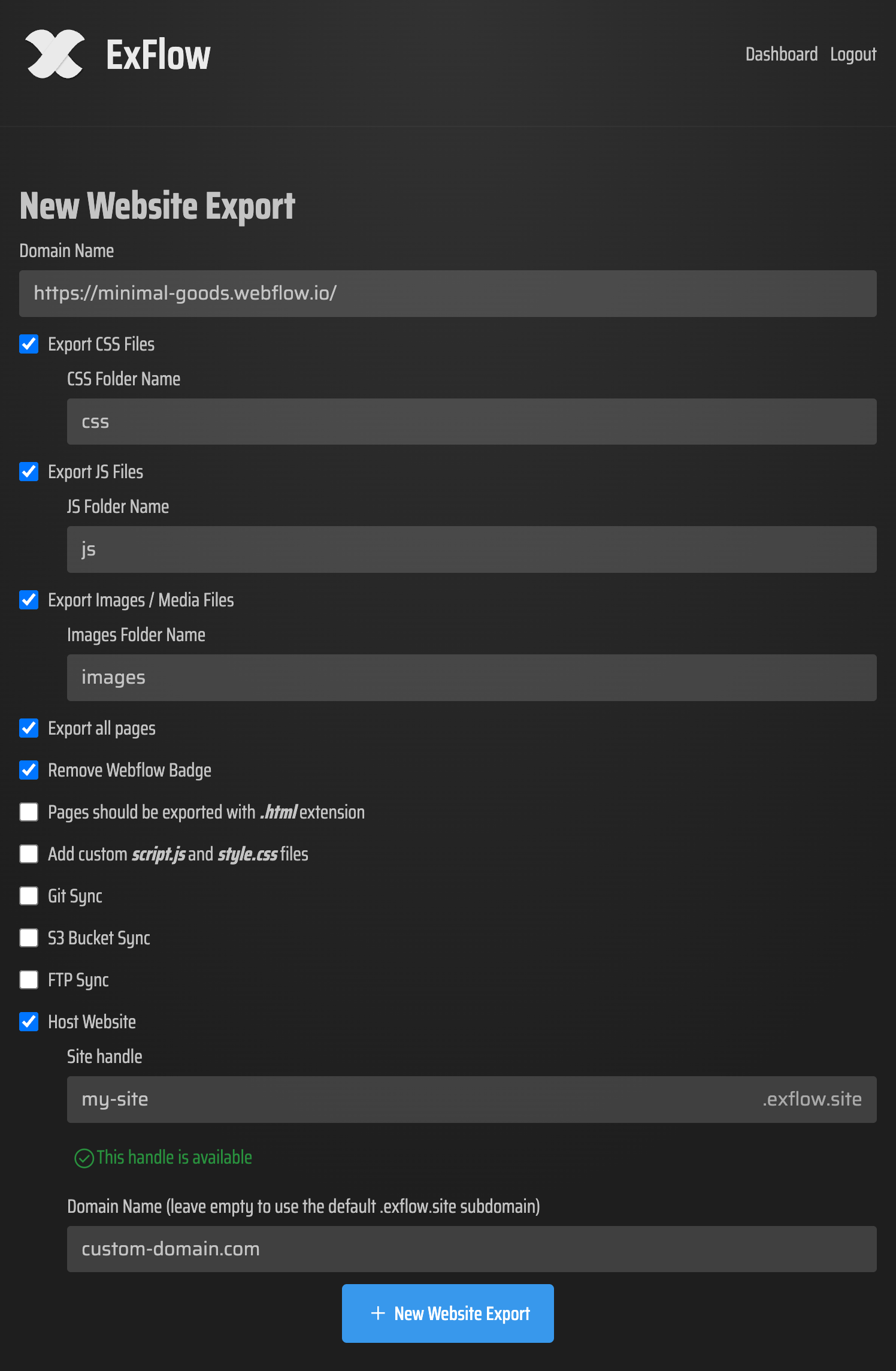
ExFlow is built for exactly that job. It exports Webflow sites as downloadable static content, including pages, CSS, JavaScript, images, and media files. It also supports exporting all pages, removing the "Made with" badge, adding custom script.js and style.css files, and syncing the result to Git, S3, FTP, or hosted delivery.
8 Title Ideas For A Webflow Export Guide
- How to Export a Webflow Site to Static HTML with ExFlow
- Webflow Exporter Guide: Download Your Site as Static Files
- How to Download Webflow CMS Pages and Host Them Yourself
- Webflow to Static: The Simplest Way to Self-Host a Site
- Best Webflow Alternative for Exporting Sites You Control
- How to Remove the Webflow Badge and Export Clean Files
- Webflow CMS to HTML: A Practical Static Export Workflow
- When Webflow Hosting Feels Too Expensive, Try Static Export

Why Export A Webflow Site At All
There are two common reasons. First, you may want cheaper or more flexible hosting. Second, you may want more control over deployment, source control, and custom infrastructure. Static export is especially useful when your site is mostly content-driven and does not need Webflow to render every request.
That does not mean Webflow stops being useful. It still gives you the design workflow. ExFlow simply gives you a way to move the output elsewhere once the site is ready.
What ExFlow Exports
ExFlow supports URL-based exporting and can include CSS, JS, images, and media files. It can export all pages, preserve them with .html extensions, and add custom script.js and style.css files when you need to layer in your own code.
It also supports hosting and deployment sync options, including Git, S3, and FTP. If you prefer to keep the site entirely on your own infrastructure, that is the cleanest route.

A Simple Export Workflow
Start with the published Webflow URL. Enter it into ExFlow, choose the export options you need, and run the export. Once the files are ready, review the HTML output, confirm that assets are present, and then deploy the bundle to your preferred host.
If you use Git, the sync path can fit into a standard CI/CD flow. If you use S3 or FTP, the same exported files can be pushed into an existing delivery setup. The main benefit is that the exported site remains portable.
When This Approach Makes Sense
This is a strong choice when you want to self-host a Webflow site, reduce dependency on a single platform, or keep a static version of a marketing site, documentation hub, or content site. It is also useful when you want a fallback copy of a build that can be served independently.
For teams comparing Webflow exporter tools, ExFlow is worth a look because it centers the export workflow rather than trying to replace your design process.
Recommended Next Step
Pick one site, export it, and verify the full path from Webflow to static hosting before you migrate anything larger. That gives you a concrete benchmark for how the workflow fits your stack.
Ready to try it? Start with ExFlow and see how your Webflow site looks as portable static files.
Comments
Post a Comment