If you’re ready to take control of your website costs and performance, learning how to download Webflow CMS to HTML and self-host safely is a smart move. In this guide, you’ll get a step-by-step workflow, security best practices, and a reliable Webflow exporter recommendation to capture your full site (including CMS pages) and serve it as fast, budget-friendly static HTML.
Why go static? Static hosting can cut monthly bills, boost speed, and eliminate backend attack surfaces—while keeping your design exactly as you intended.

What “Download Webflow CMS to HTML” Really Means
- You’ll create a static snapshot of your site: HTML, CSS, JS, images, and CMS-generated pages at the time of export.
- Dynamic features that require a backend (native form handling, on-site search, memberships, gated content) need a static-friendly alternative or third-party service post-export.
- The payoff: stability, speed, and cost savings—especially if hosting plans felt too expensive for your needs.
Meet ExFlow: The Reliable Webflow Exporter (with CMS)
If you’ve tried default options or generic site cloners, you know CMS exports are the hard part. ExFlow.site is a purpose-built Webflow downloader that captures your design and converts your Webflow CMS to HTML, retaining CSS, JS, images, and all pages. It also supports Squarespace and Framer, but its standout value here is as a Webflow exporter that actually handles CMS content.
Key capabilities you’ll use:
- Export all pages (including CMS)
- Export CSS, JS, and image/media assets
- Remove the "Made with" badge
- Automatically add custom script.js and style.css
- Sync to Git, S3, or FTP for instant deployment
- Optional built-in hosting with unlimited bandwidth and custom domains
ExFlow has multiple plans (free to start; higher limits available) so you can pick what fits your site size and workflow.
Step-by-Step: Download Webflow CMS to HTML With ExFlow
1) Enter your URL
- Go to ExFlow.site and paste the domain or staging URL of your Webflow project.
2) Configure your export
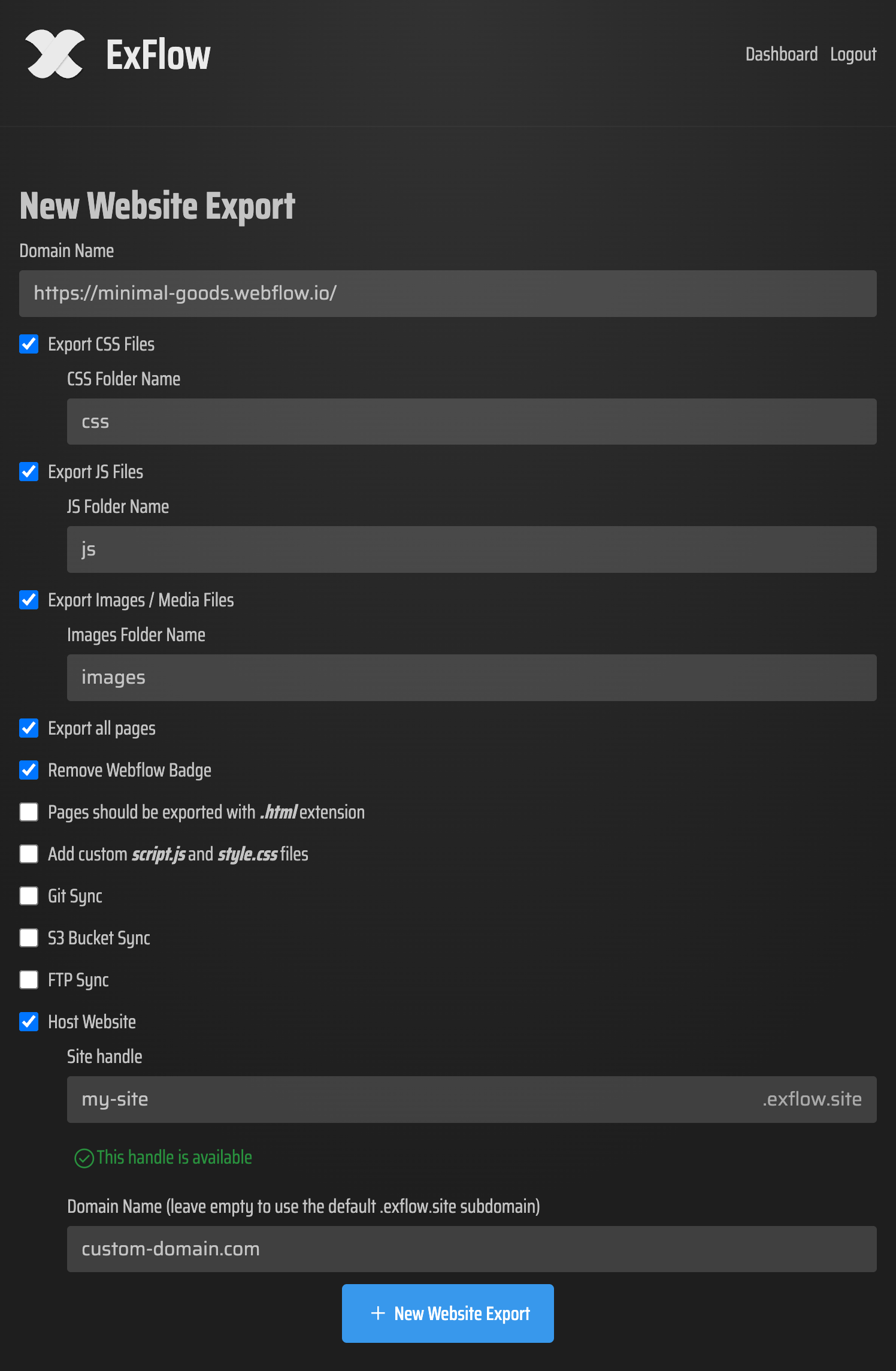
- Turn on: Export CSS Files, Export JS Files, Export Images/Media Files
- Check: Export All Pages (includes CMS templates and items)
- Optional: Remove "Made with" badge; add custom script.js and style.css; ensure .html extension is set
- If you want instant deployment, enable Sync Git, Sync S3, or Sync FTP (you’ll supply credentials securely)
3) Start the export
- ExFlow crawls your project and collects HTML, CSS, JS, images, and CMS pages into a consistent static bundle.
4) Download or auto-sync
- Download your ZIP, or let ExFlow push directly to your target (S3, Git repo, or FTP server).
5) Host anywhere (including on ExFlow)
- Use ExFlow’s built-in static hosting for a quick launch, with unlimited bandwidth and custom domain support, or pick your preferred platform.
Video walkthroughs
- How to Export CMS Pages on Webflow for FREE: https://www.youtube.com/watch?v=USu9ktYjFDU
- Export a Webflow Site for Free + Badge Removal (Webflow-Exporter): https://www.youtube.com/watch?v=38hVzKheSvs
Safe Self-Hosting Options (and How to Do It Right)
Option A: Host on ExFlow
- Easiest path: Choose hosting inside ExFlow during export
- Point your custom domain to the provided records
- Unlimited bandwidth and hosting status monitoring included
Option B: Amazon S3 static hosting
- Create an S3 bucket named after your domain
- Use ExFlow’s S3 Sync to upload the exported bundle
- Enable static website hosting; set index.html (and optionally 404.html)
- Add CloudFront or a CDN for SSL and caching
Option C: Git-based deployment
- Connect a Git repository via ExFlow’s Git Sync
- Deploy on providers like GitHub Pages or Netlify; configure build as a static publish (no build step needed if pure static)
Option D: Traditional server via FTP
- Provide FTP credentials to ExFlow
- It will upload your files to /public_html or your configured web root
- Verify correct file permissions and MIME types
Self-Hosting Safely: Security and Compliance Checklist
Credentials and access
- Use deployment-specific credentials (scoped Git tokens, S3 IAM users, or limited FTP users)
- Rotate keys and revoke unused tokens regularly
- Store secrets outside your repo; never commit them
Transport security
- Serve your site over HTTPS only (enforce HSTS)
- Redirect HTTP to HTTPS
Security headers
- Content-Security-Policy (CSP): restrict scripts, styles, frames to trusted origins
- X-Content-Type-Options: nosniff
- Referrer-Policy: strict-origin-when-cross-origin
- Permissions-Policy: limit sensors, camera, microphone
Static integrity
- Avoid inline scripts/styles where possible; keep assets fingerprinted (e.g., style.abc123.css) to enable strong caching
- Use a CDN with edge caching and DDoS protection
Compliance and ownership
- Ensure you own or have rights to all content you export
- Review platform Terms of Service; export only your own property
- For consent/cookies: re-implement banners if you rely on analytics/ads
SEO and Performance After the Export
- Canonicals and metadata: Verify
, meta description, canonical, and hreflang (if used) are intact</li> <li>Open Graph & Twitter Cards: Confirm previews remain correct for social sharing</li> <li>XML sitemap & robots.txt: Regenerate or update path references for your new domain or structure</li> <li>301 redirects: If URLs changed, create redirect rules to preserve rankings</li> <li>Image optimization: Serve modern formats (WebP/AVIF) where appropriate; enable responsive srcset</li> <li>Caching: Long-cache static assets with cache-busting file names; set sensible HTML cache TTLs</li> <li>Analytics & pixels: Replace any platform-specific analytics with your vendor of choice via your custom script.js</li> </ul> <p>Common Post-Export Questions</p> <ul> <li>Will forms still work? Native platform form handling won’t. Use a static-friendly form endpoint (Formspree, Basin, serverless functions) and update action URLs.</li> <li>What about site search? Static hosting needs a client-side search service (e.g., a JavaScript-based index or an external search API). Alternatively, provide a sitemap to a third-party search provider.</li> <li>Do animations break? With generic cloners they often can. ExFlow is built to preserve modern interactions and asset loading, making it a more reliable Webflow alternative to simple crawlers like HTTrack for complex sites.</li> <li>Can I update content later? Yes—update content in your source project, then re-export with ExFlow to refresh the static bundle. With Git or S3 Sync, redeploys are one click.</li> </ul> <p>Why Teams Choose This Workflow</p> <ul> <li>Webflow too expensive for your use case? Moving to static can dramatically lower monthly hosting costs</li> <li>Performance and Core Web Vitals: Static delivery + CDN often yields top-tier speed</li> <li>Control and portability: Keep a clean HTML/CSS/JS snapshot you can deploy anywhere</li> </ul> <p>Your Best Next Step</p> <ul> <li>Try the ExFlow Webflow exporter: Start at <a href="https://exflow.site">ExFlow.site</a></li> <li>Download Webflow CMS to HTML in minutes: <a href="https://exflow.site">Export your site with ExFlow</a></li> <li>Prefer zero-dev hosting? Use ExFlow’s built-in static hosting with unlimited bandwidth and connect your custom domain</li> </ul> <p>Additional resources</p> <ul> <li>How to Export a Webflow Site For Free: https://www.youtube.com/watch?v=QFuDqtk09qs</li> <li>How to Sync Webflow with GitHub: https://www.youtube.com/watch?v=Zvw0qiUKBYk</li> </ul> <p>Final word</p> <p>Exporting Webflow CMS to HTML and self-hosting safely is absolutely achievable—and can be a big win for speed, security, and budget. With <a href="https://exflow.site">ExFlow.site</a>, you get a purpose-built Webflow downloader that captures CMS pages, streamlines deployment (Git, S3, FTP), and even hosts for you. Keep the security and SEO checklist above handy, and you’ll have a static site that’s fast, resilient, and easy to maintain.</p> </div> <div class='post-footer container'> <div class='post-footer-line post-footer-line-1'> </div> <div class='post-footer-line post-footer-line-2'> </div> <div class='post-footer-line post-footer-line-3'> </div> <div class='post-share-buttons post-share-buttons-bottom'> <div class='byline post-share-buttons goog-inline-block'> <div aria-owns='sharing-popup-Blog1-byline-2918691825732361402' class='sharing' data-title='How To Download Webflow CMS To HTML And Self Host Safely'> <button aria-controls='sharing-popup-Blog1-byline-2918691825732361402' aria-label='Share' class='sharing-button touch-icon-button' id='sharing-button-Blog1-byline-2918691825732361402' role='button'> <div class='flat-icon-button ripple'> <svg class='svg-icon-24'> <use xlink:href='/responsive/sprite_v1_6.css.svg#ic_share_black_24dp' xmlns:xlink='http://www.w3.org/1999/xlink'></use> </svg> </div> </button> <div class='share-buttons-container'> <ul aria-hidden='true' aria-label='Share' class='share-buttons hidden' id='sharing-popup-Blog1-byline-2918691825732361402' role='menu'> <li> <span aria-label='Get link' class='sharing-platform-button sharing-element-link' data-href='https://www.blogger.com/share-post.g?blogID=8233285254376317621&postID=2918691825732361402&target=' data-url='https://the-lean-ecommerce.blogspot.com/2026/03/how-to-download-webflow-cms-to-html-and.html' role='menuitem' tabindex='-1' title='Get link'> <svg class='svg-icon-24 touch-icon sharing-link'> <use xlink:href='/responsive/sprite_v1_6.css.svg#ic_24_link_dark' xmlns:xlink='http://www.w3.org/1999/xlink'></use> </svg> <span class='platform-sharing-text'>Get link</span> </span> </li> <li> <span aria-label='Share to Facebook' class='sharing-platform-button sharing-element-facebook' data-href='https://www.blogger.com/share-post.g?blogID=8233285254376317621&postID=2918691825732361402&target=facebook' data-url='https://the-lean-ecommerce.blogspot.com/2026/03/how-to-download-webflow-cms-to-html-and.html' role='menuitem' tabindex='-1' title='Share to Facebook'> <svg class='svg-icon-24 touch-icon sharing-facebook'> <use xlink:href='/responsive/sprite_v1_6.css.svg#ic_24_facebook_dark' xmlns:xlink='http://www.w3.org/1999/xlink'></use> </svg> <span class='platform-sharing-text'>Facebook</span> </span> </li> <li> <span aria-label='Share to X' class='sharing-platform-button sharing-element-twitter' data-href='https://www.blogger.com/share-post.g?blogID=8233285254376317621&postID=2918691825732361402&target=twitter' data-url='https://the-lean-ecommerce.blogspot.com/2026/03/how-to-download-webflow-cms-to-html-and.html' role='menuitem' tabindex='-1' title='Share to X'> <svg class='svg-icon-24 touch-icon sharing-twitter'> <use xlink:href='/responsive/sprite_v1_6.css.svg#ic_24_twitter_dark' xmlns:xlink='http://www.w3.org/1999/xlink'></use> </svg> <span class='platform-sharing-text'>X</span> </span> </li> <li> <span aria-label='Share to Pinterest' class='sharing-platform-button sharing-element-pinterest' data-href='https://www.blogger.com/share-post.g?blogID=8233285254376317621&postID=2918691825732361402&target=pinterest' data-url='https://the-lean-ecommerce.blogspot.com/2026/03/how-to-download-webflow-cms-to-html-and.html' role='menuitem' tabindex='-1' title='Share to Pinterest'> <svg class='svg-icon-24 touch-icon sharing-pinterest'> <use xlink:href='/responsive/sprite_v1_6.css.svg#ic_24_pinterest_dark' xmlns:xlink='http://www.w3.org/1999/xlink'></use> </svg> <span class='platform-sharing-text'>Pinterest</span> </span> </li> <li> <span aria-label='Email' class='sharing-platform-button sharing-element-email' data-href='https://www.blogger.com/share-post.g?blogID=8233285254376317621&postID=2918691825732361402&target=email' data-url='https://the-lean-ecommerce.blogspot.com/2026/03/how-to-download-webflow-cms-to-html-and.html' role='menuitem' tabindex='-1' title='Email'> <svg class='svg-icon-24 touch-icon sharing-email'> <use xlink:href='/responsive/sprite_v1_6.css.svg#ic_24_email_dark' xmlns:xlink='http://www.w3.org/1999/xlink'></use> </svg> <span class='platform-sharing-text'>Email</span> </span> </li> <li aria-hidden='true' class='hidden'> <span aria-label='Share to other apps' class='sharing-platform-button sharing-element-other' data-url='https://the-lean-ecommerce.blogspot.com/2026/03/how-to-download-webflow-cms-to-html-and.html' role='menuitem' tabindex='-1' title='Share to other apps'> <svg class='svg-icon-24 touch-icon sharing-sharingOther'> <use xlink:href='/responsive/sprite_v1_6.css.svg#ic_more_horiz_black_24dp' xmlns:xlink='http://www.w3.org/1999/xlink'></use> </svg> <span class='platform-sharing-text'>Other Apps</span> </span> </li> </ul> </div> </div> </div> </div> </div> </div> </div> </div> </div> <section class='comments embed' data-num-comments='0' id='comments'> <a name='comments'></a> <h3 class='title'>Comments</h3> <div id='Blog1_comments-block-wrapper'> </div> <div class='footer'> <div class='comment-form'> <a name='comment-form'></a> <h4 id='comment-post-message'>Post a Comment</h4> <a href='https://www.blogger.com/comment/frame/8233285254376317621?po=2918691825732361402&hl=en&saa=85391&origin=https://the-lean-ecommerce.blogspot.com&skin=emporio' id='comment-editor-src'></a> <iframe allowtransparency='allowtransparency' class='blogger-iframe-colorize blogger-comment-from-post' frameborder='0' height='90px' id='comment-editor' name='comment-editor' src='' width='100%'></iframe> <script src='https://www.blogger.com/static/v1/jsbin/3790099508-comment_from_post_iframe.js' type='text/javascript'></script> <script type='text/javascript'> BLOG_CMT_createIframe('https://www.blogger.com/rpc_relay.html'); </script> </div> </div> </section> </article> </div> <style> .post-body a.b-tooltip-container { position: relative; display: inline-block; } .post-body a.b-tooltip-container .b-tooltip { display: block !important; position: absolute; top: 100%; left: 50%; transform: translate(-20%, 1px); visibility: hidden; opacity: 0; z-index: 1; transition: opacity 0.2s ease-in-out; } .post-body a.b-tooltip-container .b-tooltip iframe { width: 200px; height: 198px; max-width: none; border: none; border-radius: 20px; box-shadow: 1px 1px 3px 1px rgba(0, 0, 0, 0.2); } @media (hover: hover) { .post-body a.b-tooltip-container:hover .b-tooltip { visibility: visible; opacity: 1; } } </style> </div></div> </main> <div class='vertical-ad-container no-items section' id='ads' name='Ads'> </div> <aside class='sidebar-container container' role='complementary'> <div class='section' id='sidebar_item' name='Sidebar (Item Page)'><div class='widget PopularPosts' data-version='2' id='PopularPosts1'> <h3 class='title'> Popular Posts </h3> <div class='widget-content'> <div role='feed'> <article class='post' role='article'> <div class='item-thumbnail'> <a href='https://the-lean-ecommerce.blogspot.com/2026/05/squarespace-to-html-practical-export.html'> <img alt='Image' src='https://lh3.googleusercontent.com/blogger_img_proxy/AEn0k_uNM8m9z1tgPUzV0C--hxGiD-Phj4RMB2B2bbHrxW1eZQRyIKXIxPraTOEExFWybOYh2oqc_VVJmufk80bWkEdf0MOqnqHiuQ' srcset='https://lh3.googleusercontent.com/blogger_img_proxy/AEn0k_uNM8m9z1tgPUzV0C--hxGiD-Phj4RMB2B2bbHrxW1eZQRyIKXIxPraTOEExFWybOYh2oqc_VVJmufk80bWkEdf0MOqnqHiuQ=w280 280w, https://lh3.googleusercontent.com/blogger_img_proxy/AEn0k_uNM8m9z1tgPUzV0C--hxGiD-Phj4RMB2B2bbHrxW1eZQRyIKXIxPraTOEExFWybOYh2oqc_VVJmufk80bWkEdf0MOqnqHiuQ=w560 560w, https://lh3.googleusercontent.com/blogger_img_proxy/AEn0k_uNM8m9z1tgPUzV0C--hxGiD-Phj4RMB2B2bbHrxW1eZQRyIKXIxPraTOEExFWybOYh2oqc_VVJmufk80bWkEdf0MOqnqHiuQ=w840 840w, https://lh3.googleusercontent.com/blogger_img_proxy/AEn0k_uNM8m9z1tgPUzV0C--hxGiD-Phj4RMB2B2bbHrxW1eZQRyIKXIxPraTOEExFWybOYh2oqc_VVJmufk80bWkEdf0MOqnqHiuQ=w1120 1120w, https://lh3.googleusercontent.com/blogger_img_proxy/AEn0k_uNM8m9z1tgPUzV0C--hxGiD-Phj4RMB2B2bbHrxW1eZQRyIKXIxPraTOEExFWybOYh2oqc_VVJmufk80bWkEdf0MOqnqHiuQ=w1400 1400w'/> </a> </div> <h3 class='post-title'><a href='https://the-lean-ecommerce.blogspot.com/2026/05/squarespace-to-html-practical-export.html'>Squarespace to HTML: A Practical Export and Self-Hosting Checklist</a></h3> <div class='item-content'> <div class='popular-posts-snippet snippet-container r-snippet-container'> <div class='snippet-item r-snippetized'> If you want a Squarespace site you can keep, move, or host on your own server, ExFlow.site is the tool I’d look at first. It exports a Squarespace URL into static HTML, CSS, JS, and media files, and it can also sync the result to Git, S3, or FTP. Squarespace’s own export help center is useful, but it is aimed at WordPress XML and does not export everything. The official docs spell that out here: Squarespace Exporting your site . If your goal is a clean static copy you can host elsewhere, that is where ExFlow fills the gap. TL;DR Use ExFlow when you want a full static copy of a Squarespace site. Export from a URL, choose what to include, then download or sync. Keep your own files if you want cheaper hosting, more control, or a migration path. If you only need WordPress XML, Squarespace’s built-in export may be enough. What ExFlow exports ExFlow is built around the things that matter when you are trying to preserve a site outside Squarespace: site URL input CSS files Ja... </div> <a class='snippet-fade r-snippet-fade hidden' href='https://the-lean-ecommerce.blogspot.com/2026/05/squarespace-to-html-practical-export.html'></a> </div> </div> </article> <article class='post' role='article'> <div class='item-thumbnail'> <a href='https://the-lean-ecommerce.blogspot.com/2026/05/how-to-download-webflow-site-and-host.html'> <img alt='Image' src='https://lh3.googleusercontent.com/blogger_img_proxy/AEn0k_s1LSGe67Iv24uA5uLG7QI0kZFWF2Sn3ZMaKcc66K1Fc84zIu8iynppU95gz2piFPi9dFgBHdyR1MlgFDCJjw' srcset='https://lh3.googleusercontent.com/blogger_img_proxy/AEn0k_s1LSGe67Iv24uA5uLG7QI0kZFWF2Sn3ZMaKcc66K1Fc84zIu8iynppU95gz2piFPi9dFgBHdyR1MlgFDCJjw=w280 280w, https://lh3.googleusercontent.com/blogger_img_proxy/AEn0k_s1LSGe67Iv24uA5uLG7QI0kZFWF2Sn3ZMaKcc66K1Fc84zIu8iynppU95gz2piFPi9dFgBHdyR1MlgFDCJjw=w560 560w, https://lh3.googleusercontent.com/blogger_img_proxy/AEn0k_s1LSGe67Iv24uA5uLG7QI0kZFWF2Sn3ZMaKcc66K1Fc84zIu8iynppU95gz2piFPi9dFgBHdyR1MlgFDCJjw=w840 840w, https://lh3.googleusercontent.com/blogger_img_proxy/AEn0k_s1LSGe67Iv24uA5uLG7QI0kZFWF2Sn3ZMaKcc66K1Fc84zIu8iynppU95gz2piFPi9dFgBHdyR1MlgFDCJjw=w1120 1120w, https://lh3.googleusercontent.com/blogger_img_proxy/AEn0k_s1LSGe67Iv24uA5uLG7QI0kZFWF2Sn3ZMaKcc66K1Fc84zIu8iynppU95gz2piFPi9dFgBHdyR1MlgFDCJjw=w1400 1400w'/> </a> </div> <h3 class='post-title'><a href='https://the-lean-ecommerce.blogspot.com/2026/05/how-to-download-webflow-site-and-host.html'>How to Download a Webflow Site and Host It Yourself with ExFlow</a></h3> <div class='item-content'> <div class='popular-posts-snippet snippet-container r-snippet-container'> <div class='snippet-item r-snippetized'> If you have built a site in Webflow, you already know the tradeoff: design speed is excellent, but hosting costs and platform lock-in can become a problem as your project grows. If your goal is to download a Webflow site , keep the pages you already built, and host everything yourself, ExFlow gives you a direct path from hosted design to static files. That matters for teams that want lower hosting costs, a simpler deployment pipeline, or more control over the final HTML, CSS, JavaScript, and media assets. In this guide, I’ll walk through the practical workflow for exporting a Webflow site and moving it to your own hosting setup with ExFlow. What You Can Export From Webflow ExFlow is built around the idea of turning a Webflow site into downloadable static content. According to the product brief, it supports exporting the URL you provide, CSS files, JavaScript files, images and media, and all pages, with HTML output for the exported pages. It also includes options t... </div> <a class='snippet-fade r-snippet-fade hidden' href='https://the-lean-ecommerce.blogspot.com/2026/05/how-to-download-webflow-site-and-host.html'></a> </div> </div> </article> <article class='post' role='article'> <div class='item-thumbnail'> <a href='https://the-lean-ecommerce.blogspot.com/2026/05/how-to-add-color-swatches-to-shopify.html'> <img alt='Image' src='https://lh3.googleusercontent.com/blogger_img_proxy/AEn0k_vPVsDz0y1EidP-WKENP3P5r0BHYGX95XL01bdso8CrawZVaPxDPPoLAb0wNiFey0gEQwGXwVegI0QDTCMfVQ1WP1knInCtRaKoEJExQ3WLYBfytSW2Yq53PPnQRKx6IjrYhUuJNvVmbb76b81zH2RYpcQRLkl0xgvnxJw5m6ozN2ax0AYiKigHhNbr-N3PPonzScRXHF0fJ6sHkQcZS_g7GywP4JsSj1XBcK-ewKupqVWYVnY' srcset='https://lh3.googleusercontent.com/blogger_img_proxy/AEn0k_vPVsDz0y1EidP-WKENP3P5r0BHYGX95XL01bdso8CrawZVaPxDPPoLAb0wNiFey0gEQwGXwVegI0QDTCMfVQ1WP1knInCtRaKoEJExQ3WLYBfytSW2Yq53PPnQRKx6IjrYhUuJNvVmbb76b81zH2RYpcQRLkl0xgvnxJw5m6ozN2ax0AYiKigHhNbr-N3PPonzScRXHF0fJ6sHkQcZS_g7GywP4JsSj1XBcK-ewKupqVWYVnY=w280 280w, https://lh3.googleusercontent.com/blogger_img_proxy/AEn0k_vPVsDz0y1EidP-WKENP3P5r0BHYGX95XL01bdso8CrawZVaPxDPPoLAb0wNiFey0gEQwGXwVegI0QDTCMfVQ1WP1knInCtRaKoEJExQ3WLYBfytSW2Yq53PPnQRKx6IjrYhUuJNvVmbb76b81zH2RYpcQRLkl0xgvnxJw5m6ozN2ax0AYiKigHhNbr-N3PPonzScRXHF0fJ6sHkQcZS_g7GywP4JsSj1XBcK-ewKupqVWYVnY=w560 560w, https://lh3.googleusercontent.com/blogger_img_proxy/AEn0k_vPVsDz0y1EidP-WKENP3P5r0BHYGX95XL01bdso8CrawZVaPxDPPoLAb0wNiFey0gEQwGXwVegI0QDTCMfVQ1WP1knInCtRaKoEJExQ3WLYBfytSW2Yq53PPnQRKx6IjrYhUuJNvVmbb76b81zH2RYpcQRLkl0xgvnxJw5m6ozN2ax0AYiKigHhNbr-N3PPonzScRXHF0fJ6sHkQcZS_g7GywP4JsSj1XBcK-ewKupqVWYVnY=w840 840w, https://lh3.googleusercontent.com/blogger_img_proxy/AEn0k_vPVsDz0y1EidP-WKENP3P5r0BHYGX95XL01bdso8CrawZVaPxDPPoLAb0wNiFey0gEQwGXwVegI0QDTCMfVQ1WP1knInCtRaKoEJExQ3WLYBfytSW2Yq53PPnQRKx6IjrYhUuJNvVmbb76b81zH2RYpcQRLkl0xgvnxJw5m6ozN2ax0AYiKigHhNbr-N3PPonzScRXHF0fJ6sHkQcZS_g7GywP4JsSj1XBcK-ewKupqVWYVnY=w1120 1120w, https://lh3.googleusercontent.com/blogger_img_proxy/AEn0k_vPVsDz0y1EidP-WKENP3P5r0BHYGX95XL01bdso8CrawZVaPxDPPoLAb0wNiFey0gEQwGXwVegI0QDTCMfVQ1WP1knInCtRaKoEJExQ3WLYBfytSW2Yq53PPnQRKx6IjrYhUuJNvVmbb76b81zH2RYpcQRLkl0xgvnxJw5m6ozN2ax0AYiKigHhNbr-N3PPonzScRXHF0fJ6sHkQcZS_g7GywP4JsSj1XBcK-ewKupqVWYVnY=w1400 1400w'/> </a> </div> <h3 class='post-title'><a href='https://the-lean-ecommerce.blogspot.com/2026/05/how-to-add-color-swatches-to-shopify.html'>How to Add Color Swatches to Shopify Collection Pages Without Code</a></h3> <div class='item-content'> <div class='popular-posts-snippet snippet-container r-snippet-container'> <div class='snippet-item r-snippetized'> Color swatches do more than make a Shopify storefront look cleaner. They help shoppers understand available colors faster, move between variants with less friction, and browse collection pages without opening every product one by one. The challenge is that many stores need more than a default variant picker. Some merchants sell colors as variants on one product. Others split each color into a separate product page for SEO, inventory control, or merchandising. In both cases, the goal is the same: show clear swatches on product pages and collection grids without turning theme setup into a custom development project. If that sounds familiar, Supra Swatch Colors is built for exactly this use case. As of May 14, 2026, its Shopify App Store listing shows a $7.99/month plan, a 14-day free trial , and support for product pages, collection pages, linked products, image swatches, multilingual stores, and 20+ swatch styles . Why Shopify Merchants Care About Collection-Page Swatches Shopify ... </div> <a class='snippet-fade r-snippet-fade hidden' href='https://the-lean-ecommerce.blogspot.com/2026/05/how-to-add-color-swatches-to-shopify.html'></a> </div> </div> </article> </div> </div> </div></div> </aside> <!-- close sidebar-container --> </div> <!-- close centered-bottom --> </div> <!-- close centered --> </div> <!-- close page_body --> <footer class='footer section' id='footer' name='Footer'><div class='widget Attribution' data-version='2' id='Attribution1'> <div class='widget-content'> <div class='blogger'> <a href='https://www.blogger.com' rel='nofollow'> <svg class='svg-icon-24'> <use xlink:href='/responsive/sprite_v1_6.css.svg#ic_post_blogger_black_24dp' xmlns:xlink='http://www.w3.org/1999/xlink'></use> </svg> Powered by Blogger </a> </div> <div class='copyright'>The Lean eCommerce</div> </div> </div></footer> </div> <script type="text/javascript" src="https://resources.blogblog.com/blogblog/data/res/1266210259-vegeclub_compiled.js" async="true"></script> <script type="text/javascript" src="https://www.blogger.com/static/v1/widgets/851759228-widgets.js"></script> <script type='text/javascript'> window['__wavt'] = 'AAPvtVnQjiHXi1pORP7joJcJjzzM:1791054353768';_WidgetManager._Init('//www.blogger.com/rearrange?blogID\x3d8233285254376317621','//the-lean-ecommerce.blogspot.com/2026/03/how-to-download-webflow-cms-to-html-and.html','8233285254376317621'); _WidgetManager._SetDataContext([{'name': 'blog', 'data': {'blogId': '8233285254376317621', 'title': 'The Lean eCommerce', 'url': 'https://the-lean-ecommerce.blogspot.com/2026/03/how-to-download-webflow-cms-to-html-and.html', 'canonicalUrl': 'https://the-lean-ecommerce.blogspot.com/2026/03/how-to-download-webflow-cms-to-html-and.html', 'homepageUrl': 'https://the-lean-ecommerce.blogspot.com/', 'searchUrl': 'https://the-lean-ecommerce.blogspot.com/search', 'canonicalHomepageUrl': 'https://the-lean-ecommerce.blogspot.com/', 'blogspotFaviconUrl': 'https://the-lean-ecommerce.blogspot.com/favicon.ico', 'bloggerUrl': 'https://www.blogger.com', 'hasCustomDomain': false, 'httpsEnabled': true, 'enabledCommentProfileImages': true, 'gPlusViewType': 'FILTERED_POSTMOD', 'adultContent': false, 'analyticsAccountNumber': '', 'encoding': 'UTF-8', 'locale': 'en', 'localeUnderscoreDelimited': 'en', 'languageDirection': 'ltr', 'isPrivate': false, 'isMobile': false, 'isMobileRequest': false, 'mobileClass': '', 'isPrivateBlog': false, 'isDynamicViewsAvailable': true, 'feedLinks': '\x3clink rel\x3d\x22alternate\x22 type\x3d\x22application/atom+xml\x22 title\x3d\x22The Lean eCommerce - Atom\x22 href\x3d\x22https://the-lean-ecommerce.blogspot.com/feeds/posts/default\x22 /\x3e\n\x3clink rel\x3d\x22alternate\x22 type\x3d\x22application/rss+xml\x22 title\x3d\x22The Lean eCommerce - RSS\x22 href\x3d\x22https://the-lean-ecommerce.blogspot.com/feeds/posts/default?alt\x3drss\x22 /\x3e\n\x3clink rel\x3d\x22service.post\x22 type\x3d\x22application/atom+xml\x22 title\x3d\x22The Lean eCommerce - Atom\x22 href\x3d\x22https://www.blogger.com/feeds/8233285254376317621/posts/default\x22 /\x3e\n\n\x3clink rel\x3d\x22alternate\x22 type\x3d\x22application/atom+xml\x22 title\x3d\x22The Lean eCommerce - Atom\x22 href\x3d\x22https://the-lean-ecommerce.blogspot.com/feeds/2918691825732361402/comments/default\x22 /\x3e\n', 'meTag': '', 'adsenseHostId': 'ca-host-pub-1556223355139109', 'adsenseHasAds': false, 'adsenseAutoAds': false, 'boqCommentIframeForm': true, 'loginRedirectParam': '', 'isGoogleEverywhereLinkTooltipEnabled': true, 'view': '', 'dynamicViewsCommentsSrc': '//www.blogblog.com/dynamicviews/4224c15c4e7c9321/js/comments.js', 'dynamicViewsScriptSrc': '//www.blogblog.com/dynamicviews/31d4351e075118ef', 'plusOneApiSrc': 'https://apis.google.com/js/platform.js', 'disableGComments': true, 'interstitialAccepted': false, 'sharing': {'platforms': [{'name': 'Get link', 'key': 'link', 'shareMessage': 'Get link', 'target': ''}, {'name': 'Facebook', 'key': 'facebook', 'shareMessage': 'Share to Facebook', 'target': 'facebook'}, {'name': 'BlogThis!', 'key': 'blogThis', 'shareMessage': 'BlogThis!', 'target': 'blog'}, {'name': 'X', 'key': 'twitter', 'shareMessage': 'Share to X', 'target': 'twitter'}, {'name': 'Pinterest', 'key': 'pinterest', 'shareMessage': 'Share to Pinterest', 'target': 'pinterest'}, {'name': 'Email', 'key': 'email', 'shareMessage': 'Email', 'target': 'email'}], 'disableGooglePlus': true, 'googlePlusShareButtonWidth': 0, 'googlePlusBootstrap': '\x3cscript type\x3d\x22text/javascript\x22\x3ewindow.___gcfg \x3d {\x27lang\x27: \x27en\x27};\x3c/script\x3e'}, 'hasCustomJumpLinkMessage': false, 'jumpLinkMessage': 'Read more', 'pageType': 'item', 'postId': '2918691825732361402', 'postImageUrl': 'https://iili.io/qIJ5lMF.png', 'pageName': 'How To Download Webflow CMS To HTML And Self Host Safely', 'pageTitle': 'The Lean eCommerce: How To Download Webflow CMS To HTML And Self Host Safely'}}, {'name': 'features', 'data': {}}, {'name': 'messages', 'data': {'edit': 'Edit', 'linkCopiedToClipboard': 'Link copied to clipboard!', 'ok': 'Ok', 'postLink': 'Post Link'}}, {'name': 'template', 'data': {'name': 'Emporio', 'localizedName': 'Emporio', 'isResponsive': true, 'isAlternateRendering': false, 'isCustom': false, 'variant': 'vegeclub_bluegray', 'variantId': 'vegeclub_bluegray'}}, {'name': 'view', 'data': {'classic': {'name': 'classic', 'url': '?view\x3dclassic'}, 'flipcard': {'name': 'flipcard', 'url': '?view\x3dflipcard'}, 'magazine': {'name': 'magazine', 'url': '?view\x3dmagazine'}, 'mosaic': {'name': 'mosaic', 'url': '?view\x3dmosaic'}, 'sidebar': {'name': 'sidebar', 'url': '?view\x3dsidebar'}, 'snapshot': {'name': 'snapshot', 'url': '?view\x3dsnapshot'}, 'timeslide': {'name': 'timeslide', 'url': '?view\x3dtimeslide'}, 'isMobile': false, 'title': 'How To Download Webflow CMS To HTML And Self Host Safely', 'description': 'If you\u2019re ready to take control of your website costs and performance, learning how to download Webflow CMS to HTML and self-host safely is ...', 'featuredImage': 'https://lh3.googleusercontent.com/blogger_img_proxy/AEn0k_uDpiNQ30KDTaP8QPmOIeAPw9_OpnjWZJYQD_2cFDLGj09o2hqCND6Dm6HhS495O8ZhiQQyXSkShA4n-FKD', 'url': 'https://the-lean-ecommerce.blogspot.com/2026/03/how-to-download-webflow-cms-to-html-and.html', 'type': 'item', 'isSingleItem': true, 'isMultipleItems': false, 'isError': false, 'isPage': false, 'isPost': true, 'isHomepage': false, 'isArchive': false, 'isLabelSearch': false, 'postId': 2918691825732361402}}, {'name': 'widgets', 'data': [{'title': 'The Lean eCommerce (Header)', 'type': 'Header', 'sectionId': 'header', 'id': 'Header1'}, {'title': 'Search This Blog', 'type': 'BlogSearch', 'sectionId': 'search_top', 'id': 'BlogSearch1'}, {'title': '', 'type': 'FeaturedPost', 'sectionId': 'featured_post', 'id': 'FeaturedPost1', 'postId': '7787133725544951572'}, {'title': 'Blog Posts', 'type': 'Blog', 'sectionId': 'page_body', 'id': 'Blog1', 'posts': [{'id': '2918691825732361402', 'title': 'How To Download Webflow CMS To HTML And Self Host Safely', 'featuredImage': 'https://lh3.googleusercontent.com/blogger_img_proxy/AEn0k_uDpiNQ30KDTaP8QPmOIeAPw9_OpnjWZJYQD_2cFDLGj09o2hqCND6Dm6HhS495O8ZhiQQyXSkShA4n-FKD', 'showInlineAds': true}], 'headerByline': {'regionName': 'header1', 'items': [{'name': 'timestamp', 'label': 'on'}, {'name': 'share', 'label': ''}]}, 'footerBylines': [{'regionName': 'footer1', 'items': [{'name': 'comments', 'label': 'comments'}, {'name': 'icons', 'label': ''}]}, {'regionName': 'footer2', 'items': [{'name': 'labels', 'label': ''}]}, {'regionName': 'footer3', 'items': [{'name': 'location', 'label': 'Location:'}]}], 'allBylineItems': [{'name': 'timestamp', 'label': 'on'}, {'name': 'share', 'label': ''}, {'name': 'comments', 'label': 'comments'}, {'name': 'icons', 'label': ''}, {'name': 'labels', 'label': ''}, {'name': 'location', 'label': 'Location:'}]}, {'title': 'About Me', 'type': 'Profile', 'sectionId': 'sidebar_feed', 'id': 'Profile1'}, {'type': 'BlogArchive', 'sectionId': 'sidebar_feed', 'id': 'BlogArchive1'}, {'title': '', 'type': 'ReportAbuse', 'sectionId': 'sidebar_feed', 'id': 'ReportAbuse1'}, {'type': 'PopularPosts', 'sectionId': 'sidebar_item', 'id': 'PopularPosts1', 'posts': [{'title': 'Squarespace to HTML: A Practical Export and Self-Hosting Checklist', 'id': 9210884876001011747}, {'title': 'How to Download a Webflow Site and Host It Yourself with ExFlow', 'id': 1979521928047244856}, {'title': 'How to Add Color Swatches to Shopify Collection Pages Without Code', 'id': 4820193971081335510}]}, {'type': 'Attribution', 'sectionId': 'footer', 'id': 'Attribution1'}]}]); _WidgetManager._RegisterWidget('_HeaderView', new _WidgetInfo('Header1', 'header', document.getElementById('Header1'), {}, 'displayModeFull')); _WidgetManager._RegisterWidget('_BlogSearchView', new _WidgetInfo('BlogSearch1', 'search_top', document.getElementById('BlogSearch1'), {}, 'displayModeFull')); _WidgetManager._RegisterWidget('_FeaturedPostView', new _WidgetInfo('FeaturedPost1', 'featured_post', document.getElementById('FeaturedPost1'), {}, 'displayModeFull')); _WidgetManager._RegisterWidget('_BlogView', new _WidgetInfo('Blog1', 'page_body', document.getElementById('Blog1'), {'cmtInteractionsEnabled': false, 'lightboxEnabled': true, 'lightboxModuleUrl': 'https://www.blogger.com/static/v1/jsbin/120969204-lbx.js', 'lightboxCssUrl': 'https://www.blogger.com/static/v1/v-css/828616780-lightbox_bundle.css'}, 'displayModeFull')); _WidgetManager._RegisterWidget('_ProfileView', new _WidgetInfo('Profile1', 'sidebar_feed', document.getElementById('Profile1'), {}, 'displayModeFull')); _WidgetManager._RegisterWidget('_BlogArchiveView', new _WidgetInfo('BlogArchive1', 'sidebar_feed', document.getElementById('BlogArchive1'), {'languageDirection': 'ltr', 'loadingMessage': 'Loading\x26hellip;'}, 'displayModeFull')); _WidgetManager._RegisterWidget('_ReportAbuseView', new _WidgetInfo('ReportAbuse1', 'sidebar_feed', document.getElementById('ReportAbuse1'), {}, 'displayModeFull')); _WidgetManager._RegisterWidget('_PopularPostsView', new _WidgetInfo('PopularPosts1', 'sidebar_item', document.getElementById('PopularPosts1'), {}, 'displayModeFull')); _WidgetManager._RegisterWidget('_AttributionView', new _WidgetInfo('Attribution1', 'footer', document.getElementById('Attribution1'), {}, 'displayModeFull')); </script> </body> </html>