If you have built a site in Webflow, you already know the tradeoff: design speed is excellent, but hosting costs and platform lock-in can become a problem as your project grows. If your goal is to download a Webflow site, keep the pages you already built, and host everything yourself, ExFlow gives you a direct path from hosted design to static files.
That matters for teams that want lower hosting costs, a simpler deployment pipeline, or more control over the final HTML, CSS, JavaScript, and media assets. In this guide, I’ll walk through the practical workflow for exporting a Webflow site and moving it to your own hosting setup with ExFlow.
What You Can Export From Webflow
ExFlow is built around the idea of turning a Webflow site into downloadable static content. According to the product brief, it supports exporting the URL you provide, CSS files, JavaScript files, images and media, and all pages, with HTML output for the exported pages. It also includes options to remove the "Made with" badge and add custom script.js and style.css files.
That combination is useful if your actual need is not just a backup, but a site you can keep running on your own infrastructure. For many users, the real value is not the export itself. It is the ability to own the output and host it the way they want.

Why Self-Host A Webflow Site
There are a few common reasons people look for a Webflow exporter or downloader:
- They want to reduce recurring hosting costs.
- They need more flexibility than a fully managed platform allows.
- They want a static version of the site for archive, migration, or deployment reasons.
- They want to connect the exported files to a different hosting stack.
When those goals matter, a tool like ExFlow is a better fit than a generic website copier. The product is designed for Webflow, Squarespace, and Framer sites, so the workflow is meant for modern builders rather than simple HTML snapshots.
If your site depends on CMS content, export completeness becomes even more important. The product brief specifically calls out exporting all pages and handling CMS-style content, which is the part most people care about when they are considering a move away from hosted web design tools.

How The ExFlow Workflow Works
The process is simple:
- Enter the Webflow site URL.
- Choose what to export: CSS, JS, images, media, and all pages.
- Decide whether to remove the "Made with" badge.
- Add custom script or style files if you need them.
- Download the exported static content or sync it to Git, S3, or FTP.
That workflow gives you several deployment options. You can keep the files in version control, push them to object storage, upload them to a traditional server, or use ExFlow’s hosting path if that is the simplest option for your project.
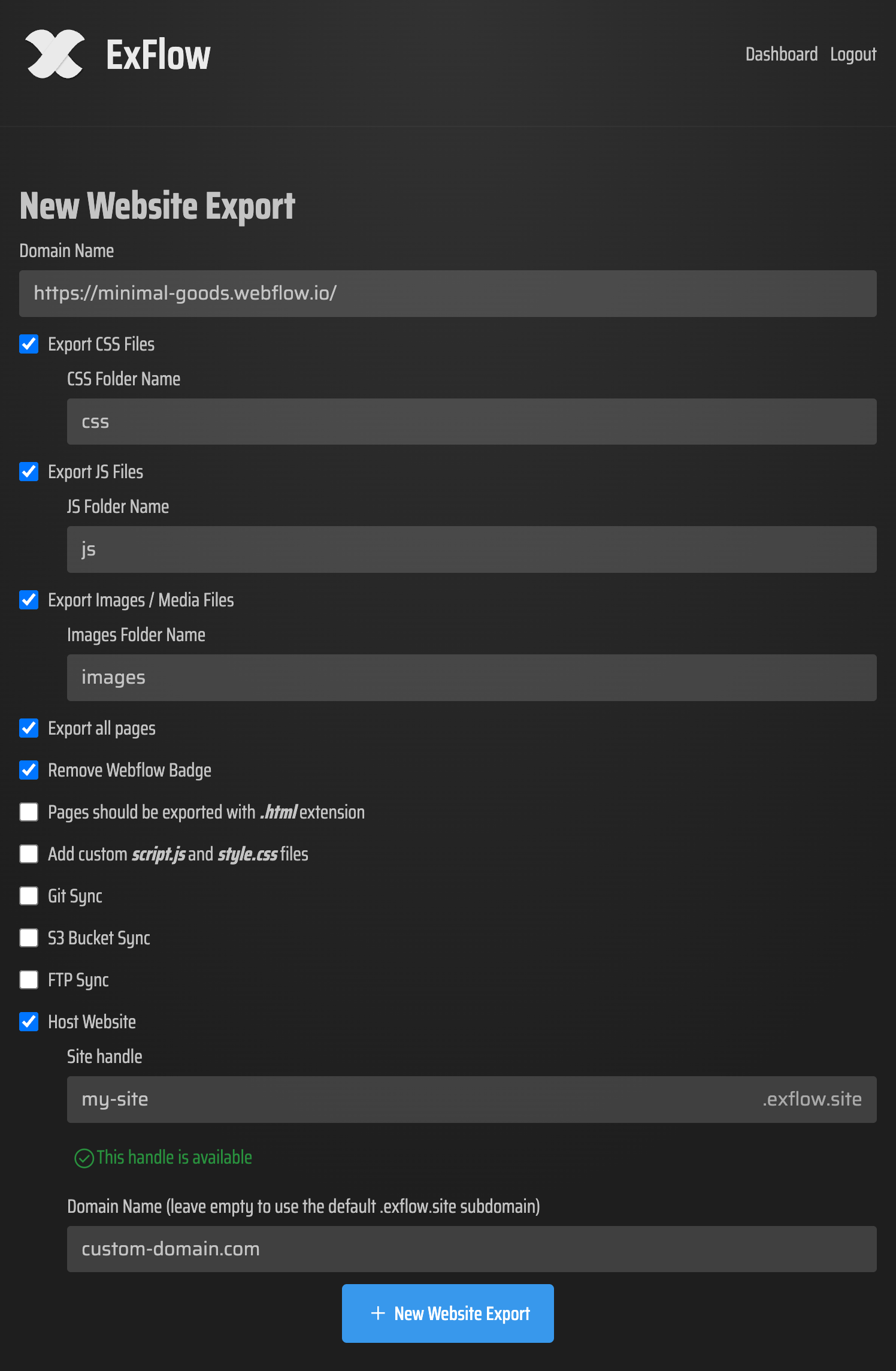
Choose The Right Export Settings
If you are exporting a production site, resist the urge to treat every setting as optional. The right configuration depends on what you are trying to preserve.
If the site is mostly static, focus on HTML, CSS, and asset export. If it includes interactive elements or custom behavior, keep JavaScript enabled. If the pages rely on images or media, export those too. If you are migrating the site to a new host, export all pages so you do not leave key URLs behind.
This is also the stage where you decide whether to sync directly to Git, S3, or FTP. That choice should match your deployment process. Git is the best fit if you want code review and history. S3 is a strong choice for static hosting. FTP can still make sense for legacy servers.
Where ExFlow Fits In A Migration Plan
ExFlow is not just for one-time downloads. It works well as part of a broader migration plan when you want to move a Webflow site into a more controllable setup. That can mean a static archive, a handoff to a developer, or a full move to self-hosted infrastructure.
If you are comparing options, the important question is whether the exporter preserves the parts of the site you actually need. For many teams, that includes all pages, CSS, JS, images, and a clean HTML output. ExFlow is positioned around exactly that workflow, which is why it is a useful Webflow exporter rather than a generic downloader.
For adjacent workflows, you may also find it useful to compare other export and automation articles in this series, such as How to Export a Webflow Site to Static HTML with ExFlow and How to Build a Browser-Based MP4 Export Pipeline with VideoFlow. Different tools solve different export problems, but the common thread is ownership over the output.
Final Take
If your goal is to download a Webflow site and host it yourself, ExFlow gives you a practical path from hosted design to static output. It supports the export settings that matter, helps you keep the files organized, and gives you options for Git, S3, FTP, or hosted delivery.
If you want more control over a Webflow project, start with the export, verify the pages and assets, and then move the site to the hosting setup that fits your workflow. That is the simplest way to reduce dependency on a single platform while keeping the design work you already completed.
Next step: review your Webflow site, export it with ExFlow, and confirm the resulting HTML and assets match the pages you need to keep.
Comments
Post a Comment